Appreciate
When the value of stocks matter more than the value of a farmer's labor.

Companies like Deere & Company, do not make their John Deere tractors small and affordable enough to where a farmer can keep doing what they have been doing. Instead, the incentive is to expand acres or do more within those acres to make up the cost of the tractor. Despite tractors being built to help a small farm, the cost of the tractor is going to eat more at the cash flow than it did many years ago.
This results in tractors not being built to create sustainable farming communities, keeping wealth in these communities, and falling in line with a farmers’ pocketbook. This leads to the expansion of acres and consolidation of farms as farmers look to spread the higher costs across more acres. This high-cost problem is put on the farmer instead of looking at why Deere & Company could also help focus on this issue.

Like a car, farm machinery assets depreciate. During my time farming, it was hard to fathom investing in a depreciating asset. If I were to use a depreciating asset like farm machinery to invest in an appreciating asset like land, it may have been worth it. Since investing a significant amount of change to go into debt to afford a depreciating asset, it did not make sense to start this process when the capital demands are so high. This was only for one piece of machinery and other machinery demands were going to be needed over time. The love of the game can only go so far until financial reality hits the wall.
For Deere & Company, their financial reality is the opposite. As farmers are hit with higher machinery costs, higher repair costs, and depreciation, Deere and Company’s stock price appreciates. When it makes sense to own a stock more than machinery, something is wrong with the economic system. Hard work and grit (labor) are not properly valued as a piece of paper (stock) sees a higher return on capital1. With human labor devalued and an appreciating stock being preferred, this leads to wealth inequality, water quality issues, and the hollowing out of rural communities. This is a result of less incentive to farm which leads to a less resilient food system and the consolidation of power to fewer input providers like Deere & Company and grain processors.
For example, if I invested $80,000 in a tractor in 2021 to use on rented land versus investing $80,0002 into Deere and Company’s stock, the tractor would depreciate to less than $80,000 while the $80,000 invested into a stock3 would now be worth $146,285.32 from a 182.6% return.
From a machinery financial aspect, it makes more sense to be an investor than a farmer. This tracks across the various companies touching agriculture despite the headwinds farmers are facing.
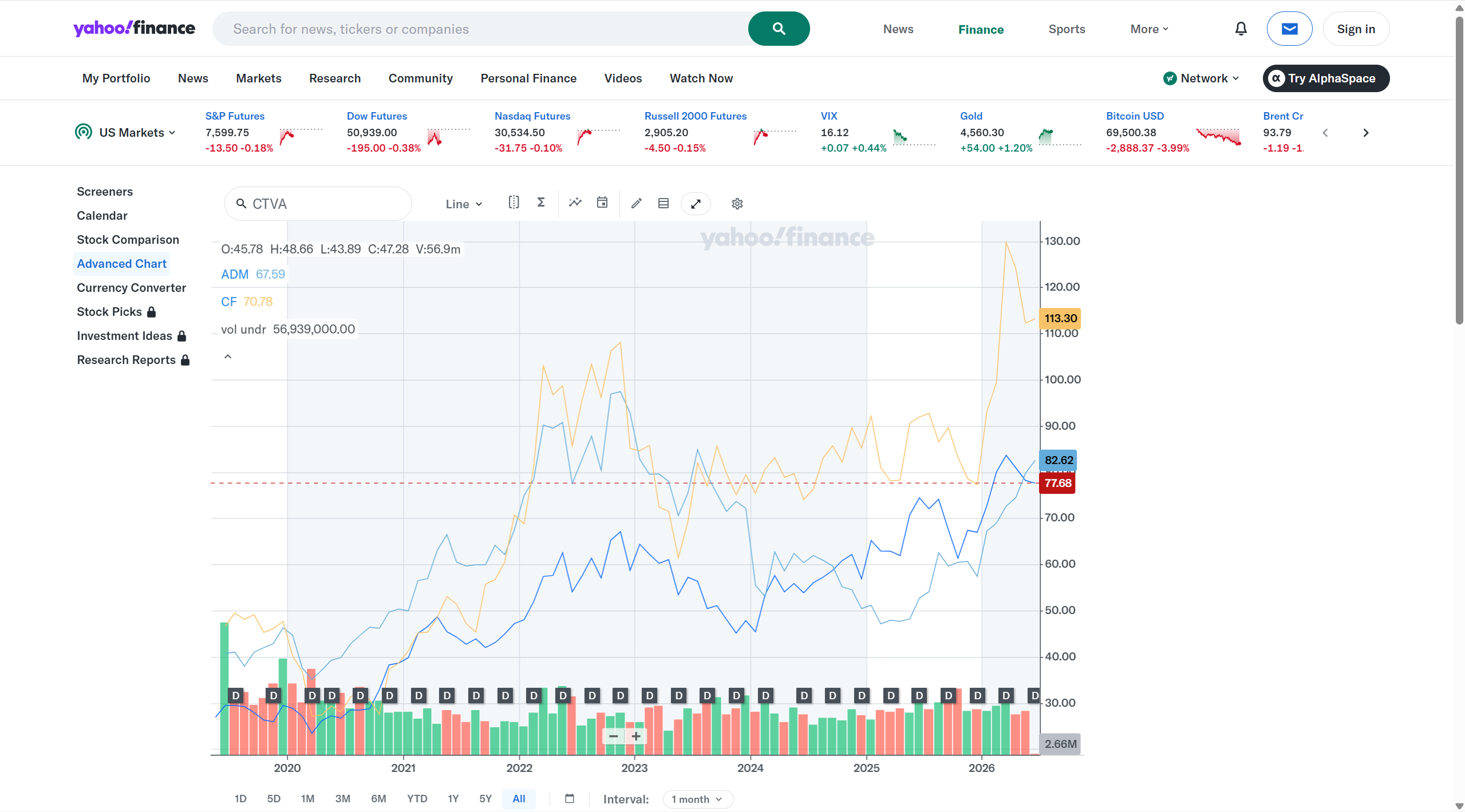
This divide between the labor of a farmer versus being a capital mover pushes the incentive to leave the farm. If everyone leaves the farm, who will be left to farm?
This outrageous rate of return on capital is unsustainable and leads to the outcomes, less farmers and hollowed out communities afflicting rural America. Deere & Company’s high stock prices rely on farm equipment prices rising to help pad their bottom line. When farmers labor is devalued like the products they produce4, farmers must expand and consolidate acres or utilize off farm income to keep the farm afloat. Instead of using their labor to make money, farmers rely on their own financial assets.
For the farmers who buy land or inherit land, this is the greatest asset. Like the stock market, the number always goes up. Land prices are buttressed by the government from biofuels to crop insurance so long term, land prices have nowhere but to rise. Farmers who own land also need increasing land prices. When land prices rise, bankers are more apt to lend to these land-owning farmers. From AgAmerica:
Farm real estate is the biggest and most valuable part of a farmer’s assets. Because of this, land value plays a big role in farm loans.
As land value rises, farmers build equity—the difference between what the land is worth and what’s still owed on it. More equity makes it easier to refinance, because the loan is seen as less risky to lenders.
After staying mostly steady from 2014 to 2020, farmland prices started going up in 2021—even when you account for inflation. That upward trend has continued through 2024, increasing by five percent. This increase puts farmers in a strong position to refinance their loans.
These increasing farmland values could lead to more exposure to banks if an agriculture downtown were to occur. It is imperative farmland value maintains or rises. This not only hurts the beginning farmer who is trying to buy their first piece of land, but it leads to more consolidation as land prices rise. If a 1980s like agriculture happens again, large farms might be better positioned to take advantage of this crisis than smaller farmers which will lead to more consolidation based on this page 17 of this old USDA document.
While the four studies did not find a consistent pattern of exit among operators of small, medium, and large farms, the rate of involuntary exit was generally lowest among the operators of large farms (with the exception of large farms, as measured by gross farm sales, in Georgia). This would seem to support the predictions that farms are becoming more concentrated into large enterprises.
When small farmers lose their land, it can be gobbled up by the bigger farmers. This also sounds familiar. While there is also evidence small farmers weathered the 1980s better due to off-farm income, this raises the question as to why an industry focused on producing food puts farmers in a position where they need an extra job to keep it afloat. There are not too many doctors, insurance agents, or scientists using a second job to keep industry and livelihood afloat.
These industry conditions have led farmers from being a caretaker of the land and providing for their community to being a financial manager, whether they wanted to or not. This happens when the value by the economic system is placed on the appreciation of stocks and not farmers’ labor or producing affordable machinery, certain outcomes become apparent. What is happening with financial power and wealth consolidating away from independent farmers into the hands of a few financial behemoths like Deere & Company, Corteva, ADM, and CF Industries, leads to worse water quality, struggling rural economies, and less farmers.
For this to change, the farmer side of the agriculture economy equations needs to be favored whether through affordable equipment or rewarding their labor. By enforcing antitrust laws and better protecting farmers from being taken advantage of by companies with outsized market power, these goals can be met. Economic prosperity is meant to be shared, not hoarded by the few in agriculture supply chain. When independent family farms succeed, all Americans succeed.
I also say this as someone who invests in index funds because this is the best rate of return. This is the problem of the economic system is the best path towards retirement is also propping up a system trying to reduce the labor cost.
It also does not help the rules around index funds apparently can change rules willy nilly, potentially exposing many Americans to an unprofitable company, whether they like it or not.
Assuming in Jan 2021, my first year farming with dad, I had $80,000 in cash, which I definitely did not. I like to assume someone gave me a zero interest loan because they enjoy my personality.
The stock price was $288.80 in January 2021 and on May 23, 2026, it was $528.09. This equals 182.86% return. Please let me know if my math is wrong.
My favorite piece of USDA data to look at each month is parity pricing. According to Investopedia, for agricultural commodities, the parity price is the purchasing power of a particular commodity relative to a farmer’s expenses, such as wages, loan interest, and equipment. The Agricultural Adjustment Act of 1938 defines parity price as the average price farmers received for commodities over the past 10 years. If this parity price is below the market price, the government might provide price support through direct purchases.
When you look at corn and soybeans, the current market price for corn and soybeans is way below the parity price. This means the value of labor in producing these commodities is completely out of whack.