Patents

When I farmed, the most important input was seeds. If I did not plant seeds, I was not a farmer. I could have still driven a tractor around a field, chewed on foxtail, and went to the local gas station to talk to fellow farmers about the weather. Despite these other qualifying factors, no seed meant I was not a farmer.
Seeds are not only vital for a farmer to farm, but seeds are also vital for life. If nothing grows, the world is a vast, barren desert like Mars. What used to be a process of where seeds were originally bred and improved on by public institutions, seeds like corn and soybeans have since been transferred from public breeding to private industry. The reasons are why this shift occurred, but one specific reason is private capital could help drive research and development.

While this is the case in a competitive industry, a monopolized industry like the seed industry, private investment needs to be questioned. In an industry where the top four companies control over 78% of the soybean seed market and over 83% of the corn seed market with two companies, Corteva and Bayer, controlling over 65% of the soybean seed market and over 71% of the corn seed market according to Farm Action, this monopolization has led to a lack of creativity and more protecting their interests. In my previous post, I wrote about how these companies have used patent laws to protect their business and deter competition.
When a company like Bayer can allegedly still control its NK603 genetically engineered corn trait which makes corn resistant to glyphosate despite no longer being under patent, this monopoly power hurts other seed companies, farmers, and rural communities. For Bayer, this is not about feeding the world, it is about protecting a financial asset.
Obviously, patents and copyrights are similar but not the same. According to the United States Patent and Trademark Office, “patents are technical inventions, such as chemical compositions like pharmaceutical drugs, mechanical processes like complex machinery, or machine designs that are new, unique, and usable in some type of industry. Copyrights are artistic, literary, or intellectually created works, such as novels, music, movies, software code, photographs, and paintings that are original and exist in a tangible medium, such as paper, canvas, film, or digital format.”
The original intent of patents and copyrights makes sense. They are meant to protect the creator and give them a return for their hard work. If nothing could be patented or copyrighted, it would be harder to justify the time, effort, and money into making an invention or piece of work. Unfortunately, this has been abused by monopolized industries like seed companies. These companies now use these protections to corner their market and use these patents and copyrights to be less creative. Like Bayer hoarding the value of the glyphosate resistant trait, Disney has also hoarded the value of Mickey Mouse.
After many years of being protected and copyright law being extended, the original Steamboat Willie version of Mickey Mouse entered the public domain in 2024. This is only 29 years after the original date it was supposed to enter before these extensions according to NYU Law. Due to this extended protection, Disney retained control over the Steamboat Willie which deprived other creatives of potential creations based on this version of creating a work of monetary value. Disney retained value and prevented competition due to the protection of Steamboat Willie.
This also goes the same way for seed companies to protect their financial assets like a glyphosate resistant corn seed. “According to a report from the Department of Agriculture’s Economic Research Service, the price for genetically engineered seeds has more than quintupled since 1990, rising by 463%. But over that same period of time, the price farmers have received for their crops has increased only by 56%,” according to The Conversation.
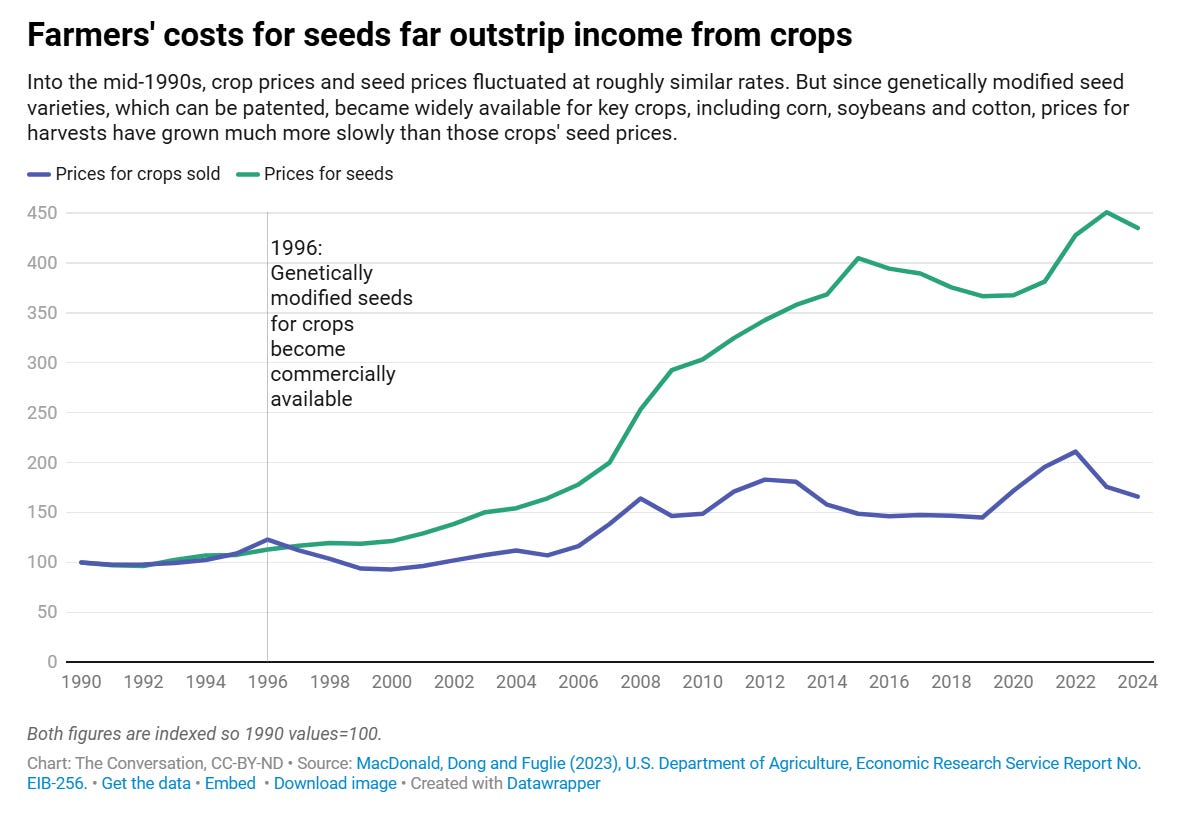
Companies need to be protected for their innovation, but it can only go so far. When economic harm happens to farmers and the rural communities they serve, the patent power they get to extend their monopoly power needs to be examined. This power allows them to milk money from public taxpayers. According to The Conversation, a 2025 study showed for every 1% increase in farm subsidies, seed companies raised their price by 0.5%.
This impact is felt on farmers, rural communities, and water quality. Whether it is the cost farmers pay for seed which leads to less farmers on the land in addition to less people in rural communities, the lack of competition due to the patents are a problem. Less farmers mean more consolidation and more push to grow more bushels to pay for the rising costs. This leads to a negative impact on water quality, affecting those upstream and downstream. Everyone is impacted by a monopolistic company like Bayer cornering the market on a vital resource.
Seeds are a vital resource to the entire world. When a company can treat this vital piece of life as a financial asset, negative effects occur. The importance lies in reforming patent laws. These laws need to protect what is rightfully deserved but not abused to the detriment of the public. Enforcing antitrust laws to create competitive markets will also help prevent companies from acquiring various companies and cornering an entire market and the patents which exist in it. When only two companies in the corn and soybean seed markets control on majority of the market, this is a problem. They can restrict access to plant genetics which reduces the diversity of seeds and weakens our food security according to Farm Action.
This is not only a problem for farmers but every American. Allowing industry to be monopolized in this way hurts many. By creating competitive seed markets, companies compete on their own merits and not who holds the financial power. This will be better for farmers, rural communities, and our water quality.
Many important truths have been encapsulated in this article. That qualifies for copyright protection right?