Phosphate Fertilizer

Economics 101 is learning about supply and demand. When supply goes down, the price goes up. When demand goes down, the price goes down. For example, if a business sells a widget at $2 and the market demand goes up, the price goes up (i.e. $5) to meet the demand. At the same time, potential widget competitors will enter this market to provide new supply to drive the price back down to $2 for consumers.
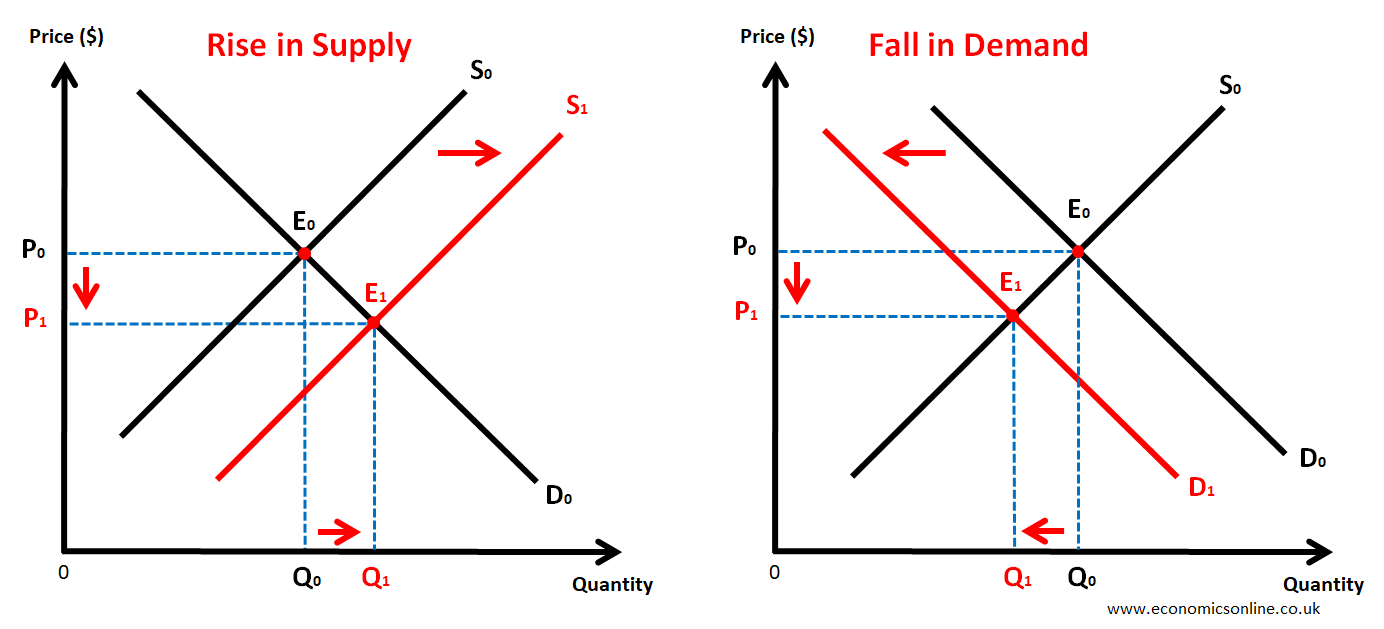
This is how the free market will work until it does not like the phosphate market. While phosphate prices continue to rise according to the USDA Iowa Production Cost Report (for monoammonium phosphate - 5% since January 9, 2026 and 120% since January 14, 2020), the market leader, Mosaic, who controls 66% of the North American phosphate fertilizer capacity, is dialing back capacity due to the rising prices of raw materials like sulfur according to Progressive Farmer. If a company with this much market power cannot figure out how to produce phosphate in times when price is telling them to produce phosphate products like MAP, maybe having one big business run the market is not efficient. More competition would help drive down these prices for farmers.
Unfortunately or fortunately, Americans have faced this problem before. In 1939, six companies controlled nearly the entire market according to Farm Action. “Working primarily through export cartels organized under the Webb-Pomerene Act, these incumbents cut deals with foreign syndicates, such as I.G. Farben in Germany and Imperial Chemical in Japan, to limit fertilizer imports; prevented independent firms from accessing fertilizer raw materials; and repeatedly buried innovative fertilizer compounds (such as TSP, SPA, and UAN solution) instead of commercializing them, to avoid rendering their existing products and plants obsolete.”
When one company controls two-thirds of the North American phosphate fertilizer capacity, it can only be assumed they are also holding back American innovation from delivering better phosphate products at lower costs to the American farmer in addition to squeezing the American farmer on price. Our forefathers in the mid-20ths century used World War II as a catalyst when the DOJ and FTC used antitrust lawsuits to breaking up these foreign syndicates. Other parts of the federal government also helped kick start American phosphate production according to Farm Action.
Federal financing led to thirteen farmers’ cooperatives building new superphosphate plants to compete with the “Big Six” fertilizer producers. The Tennessee Valley Authority also helped fill pent-up demand by commercializing cheaper and more portent fertilizer compounds and solutions with its new state-of-the-art fertilizer plants. TVA also created new fertilizer production technologies which reduced the need for high-cost inputs, like coal and phosphate rock, and shared this knowledge with fellow independent firms in the industry to strengthen their competitive position.
This led to nearly 100 companies operating over 200 superphosphate plants, and over 600 firms were operating 978 fertilizer-mixing plants around the country in the 1950s. This explosion of independent phosphatic fertilizer producers led to better supply as new operators entered the phosphate-rock mining industry helping cultivate long-neglected deposits in the Mountain states, including Idaho and Utah.

Farmers and consumers saw many benefits from this newfound competition according to Farm Action. As fertilizer consumption grew rapidly, domestic production of all three fertilizer nutrients met or exceeded demand. American farms nearly double their use of fertilizer between 1939 and the 1970s. Fertilizer consumption grew from 7.91 million tons (1938-39 crop year) to 39.37 million tons (1969-70). During this time, production growth continually outpaced demand, fertilizer prices remained stable or decline, and the DOJ and FTC made sure the markets stayed competitive. Between 1957 and 1969, anhydrous ammonia prices fell by more than 50% and TSP, a phosphate fertilizer, declined by 10 to 20%. Farmers spent less than 7% of their annual revenue on fertilizer in 1969 ($1,131 out of $16,705) while receiving $3-5 in higher crop yield for every $1 they spent.
This was a successful system. Unfortunately, something changed when at least 100 companies were operating over 200 superphosphate plants in the 1950s to Mosaic controlling two-thirds of the North American phosphate fertilizer capacity in 2026.
Like many other markets, the lack of antitrust enforcement, especially after the 1970s, have left farmers in a market with high prices, lack of innovation, and controlled by a low amount of companies. When Mosaic and its affiliates account for approximately one-half of the world’s phosphorus trade, the supply and demand curve may not work as intended. When competitors have no chance, there is no need to meet demand and help lower prices. Mosaic also mostly controls phosphate rock and fertilizer production in Saudi Arabia, Brazil, Paraguay, and Peru according to Farm Action.
“At this moment, none of the major foreign players in potassium, phosphorus, and nitrogen production are significant competitors at any level of the U.S. market. In 2021, the Commerce Department responded to petitions filed by Mosaic in 2020 by imposing “countervailing duties” on imports of phosphate fertilizers from Morocco and Russia, which will remain in effect until 2026 unless earlier repealed.”
Like those who do not want to centralize power in the government, private industry should not be centralized into one business. The supply and curve window has gone out the window. This leads to bad outcomes for farmers, rural economies, and food security.
This also leads to a great outcome for the stock market or at least Mosaic is trying to help investors out. A couple days after announcing the scale back of phosphate production on May 11, Mosaic’s stock price rose but not for long. Monopoly power is good for investors and less competition is better. Tucked at the end of this Successful Farming article reveals why the stock has suffered after this announcement and the game, “The Tampa, Florida-based company reported adjusted earnings of 5 cents per share for the quarter, below analysts’ estimate of 24 cents, according to LSEG data.”
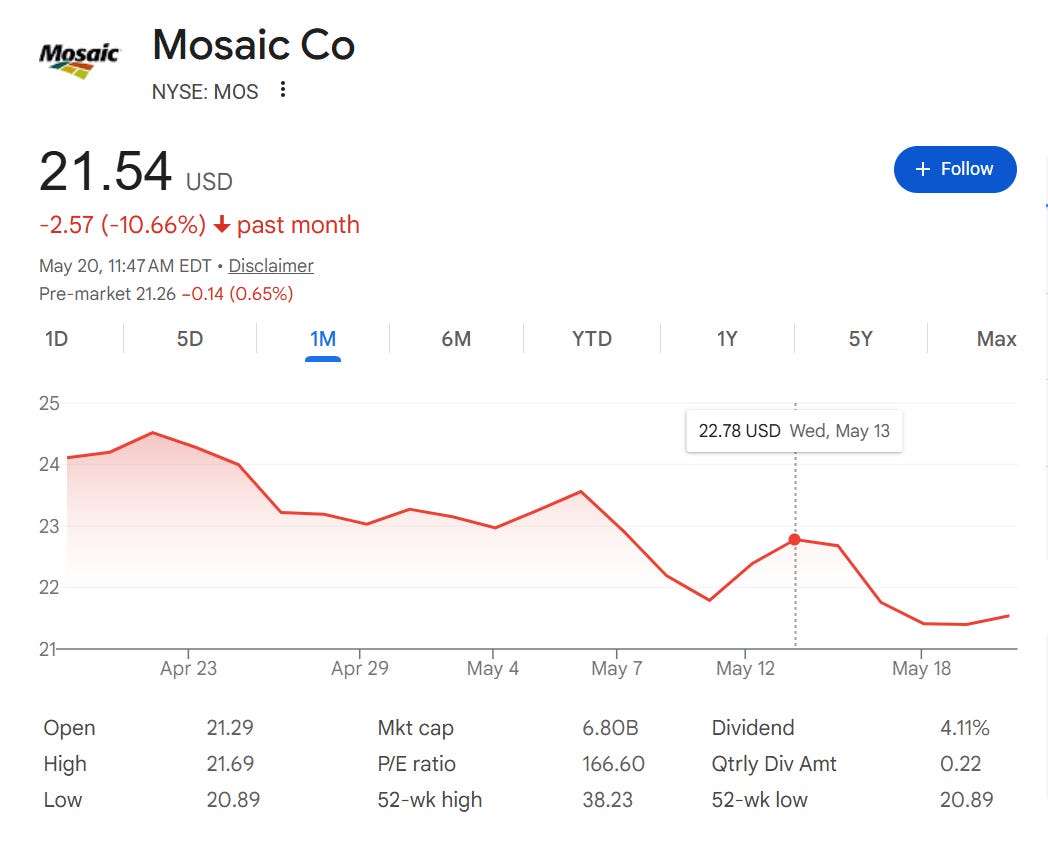
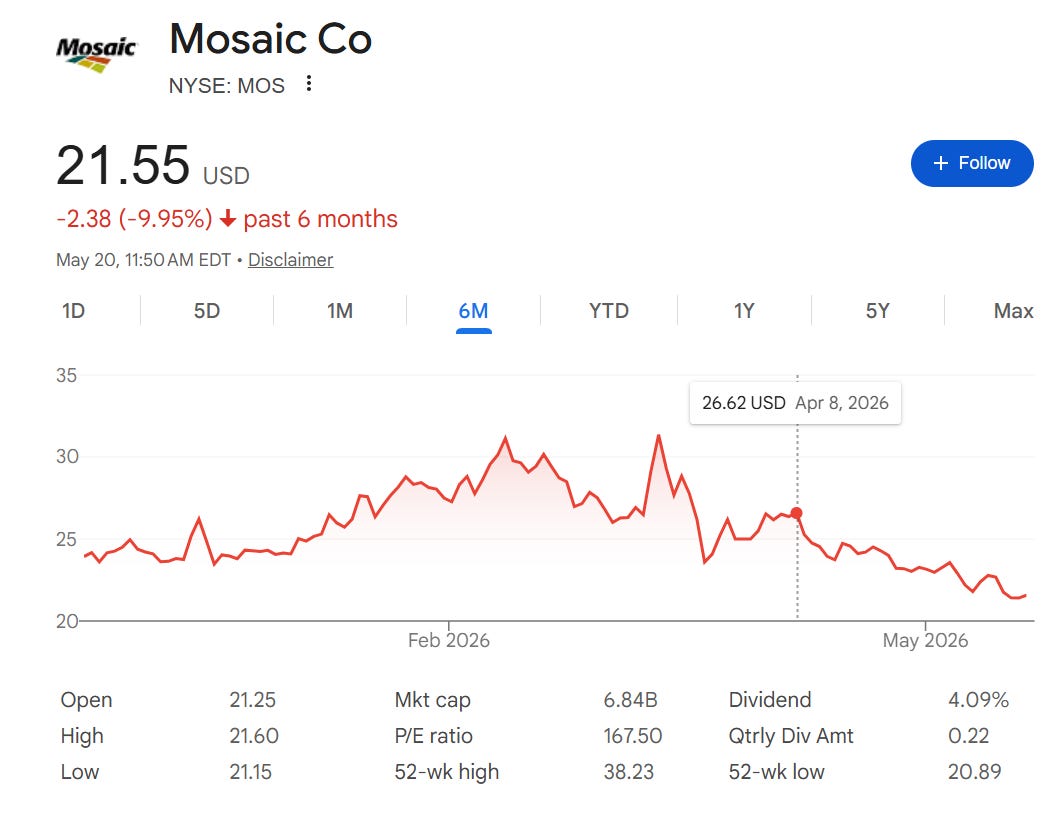
This is not about meeting the expectations of farmers, rural economies, or food security, it is about meeting stock market expectations. This is not the first example. When Mosaic announced the idling of a couple phosphate production facilities in Brazil on April 8, the stock price peaked that same day.
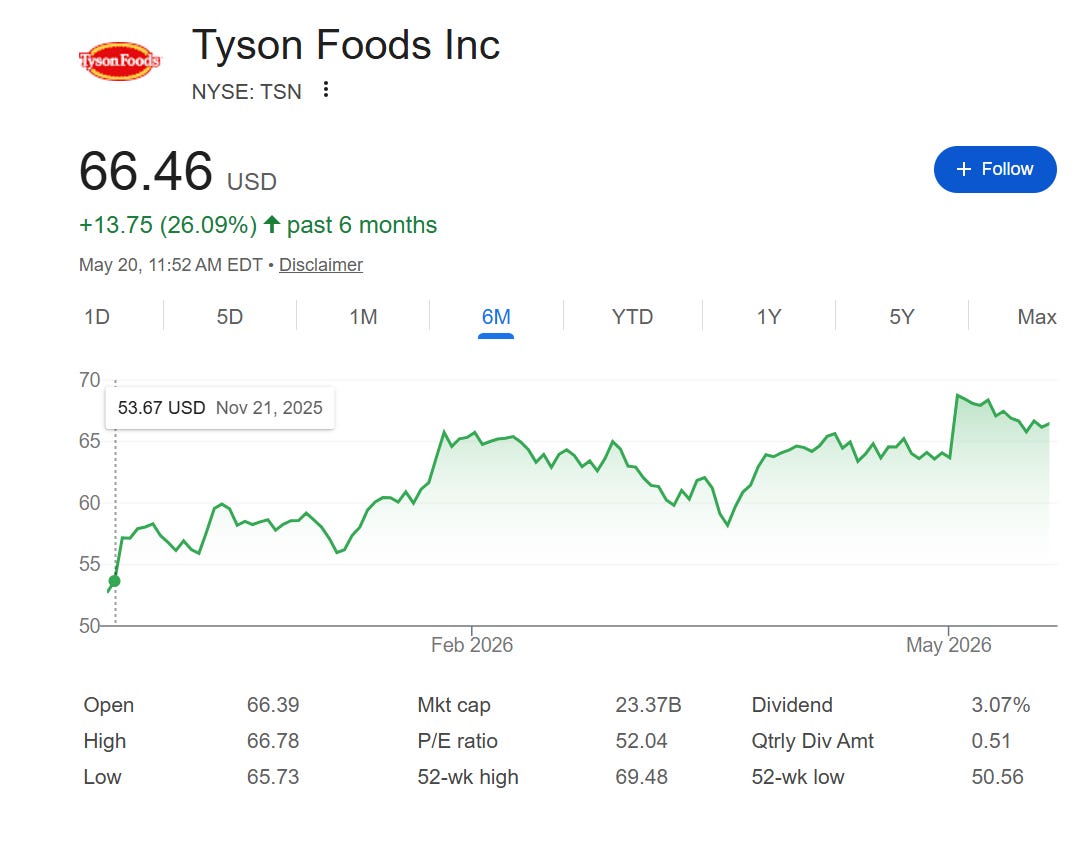
This also happens in other parts of the agricultural economy. When the Lexington, Nebraska, Tyson plant closure was announced on November 21, employees were losing their jobs in addition to 4.8% of the daily U.S beef slaughter disappearing, but the stock price also rose the next day.
By consolidating these industries and making it a monopoly has not led to so called efficiencies for big business. According to Progressive Farmer, “Trent Kubik, president of the South Dakota Corn Growers Association, told United States Senators, industry vertical integration also has not led to efficiency gains being passed on to farmers, Kubik said. Fertilizer companies have been known to basically dock barges of fertilizer supplies rather than releasing those products to lower prices.
“Instead, our experience is that the integration has resulted in the largest fertilizer companies locking up and leveraging distribution channels, entrenching their dominant positions and extracting excessive profits from farmers and consumers,” Kubik said.”
Do we want an economy to produce for Americans, employ Americans, and spread wealth throughout the countryside or do we want it to continue to centralize and be controlled by the few?
Whatever this economy is, the supply and demand curve is not working. When high prices implore a company to produce more phosphate products, they choose to shut off capacity. With Mosaic controlling two-thirds of the North American phosphate fertilizer capacity and using this leverage to also control a decent chunk of the world phosphate supplies, everyone is at their whims. This is not the free market.
The solution is simple. Americans did it in the mid-20th century, and they can do it again. The economy needs to work for everyone, not those invested in these companies and those in the boardrooms. Americans need competition by enforcing antitrust laws to create competitive markets and breaking up these companies like we did many years ago. This creates a more robust job market, more production, and better prices for farmers and consumers. Now is the time before it is too late.