
Seeing Nathan’s Famous was recently bought by Smithfield Foods was not good. Whether it is vertical integration or further consolidation in the food space, this creates less competition and gives Smithfield more market power. A hot dog company backed by a meatpacker will be harder to beat. Farmers and consumers will be squeezed more due to this newly gained power.
The other concern is having one of the most iconic American foods, a hot dog served with a bun, which is part of a popular eating competition on the day we celebrate this country’s founding. Throw this on top of being the 250-year celebration of this country’s founding, and the vibe seems off.

In contrast, Americans decided there a problem with China controlling our social media space and forced a sale of TikTok. Food should also fall under this reasoning. The most important part of having a happy country is keeping a well-fed population. With the United States exporting this skill to our greatest global competitor, something does not smell right, and it is not the pigs Smithfield owns.
Buying up a company like Nathan’s Famous is nothing new for Smithfield. Smithfield started in the 1930s in Smithfield, Virginia. With the lack of antitrust enforcement starting in the 1980s, Smithfield started to acquire companies1 to create a dominant position in the pork market.
During the rise of Smithfield, this consolidation also led to consolidation across the meatpacking industry. This has led to the consolidation of business lines within Smithfield which results in the closing of meatpacking plants. Due to their market power, the closure of a plant takes away a market leading to less competition for hog farmers. It is hard for a new plant to open in this highly consolidated market. After buying up a lot of their competition, Chinese owned Shuanghui International2 bought Smithfield Foods in 2013. This acquisition has not led to the best results.
This deal did not go without a hearing in front of Congress. As the NPR report from this time stated, Larry Pope, then Smithfield CEO said, “This means increased capacity for U.S. producers, more jobs in processing and more exports for the U.S. economy.” This did not happen.
According to the Open Markets Institute, this consolidation path led to Smithfield’s Sioux Falls, South Dakota, plant accounting for 4% to 5% of national pork processing. Like what Americans saw during the beginning of COVID, this consolidation can severely impact processing. When a plant went down during COVID, it means less capacity. If there were more plants spread out across the country, the market could better sustain a plant shutting down. It is easier to stop a train of five cars than one with 150 cars.
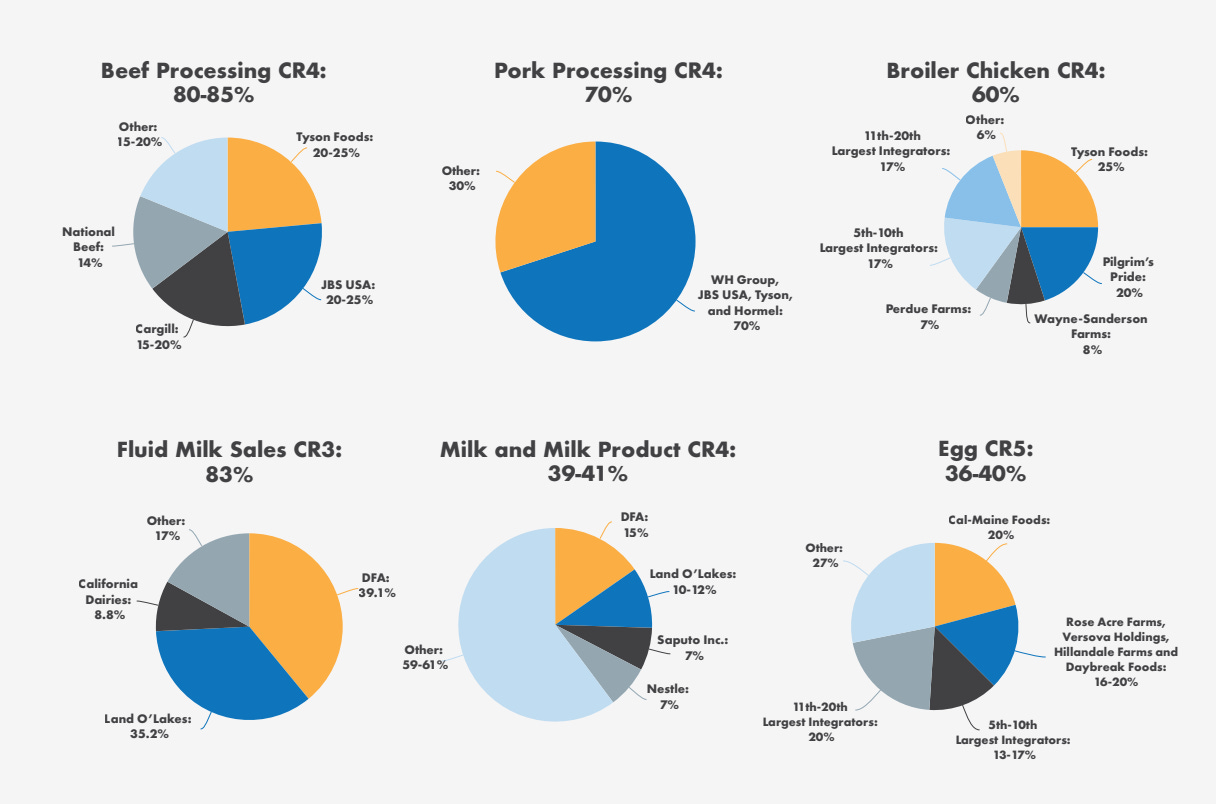
This consolidation has led from 87 percent of hogs being sold on the open market to less than 7% between 1993 and 2020 according to the Open Markets Institute. While farmers have been in a lurch, the consolidation of meatpacking to four major firms controlling 70% of the market has also impacted worker conditions according to trade union representatives in these fields. The consolidation hurts everyone across the board but those at the top. Worker conditions have gotten to a point where Smithfield had to destroy more than 50,000 pounds of its products after a worker allegedly urinated on the production line.
Smithfield has also used its market power to consolidate hog producers in addition to using their outsize control to pick winners and losers. For example, Maxwell Foods LLC filed a lawsuit days after announcing the permanent closure of its hog operations in 2021. Maxwell claimed Smithfield “failed to provide Maxwell with “most favored nation pricing” as required by the Production Sales Agreement, its refusal to provide Maxwell a fair price and its failure to purchase Maxwell’s output as required by the PSA. all have harmed Maxwell greatly and are intended to run, and are in fact unlawfully running, Maxwell out of the business.”
Pricing was based on the Iowa-southern Minnesota spot (open) market, but as the industry consolidated, less hogs went through these markets which undermined the stability and reliability of these prices. Maxwell also claimed due to consolidation and Smithfield’s aggressive vertical integration, the pricing from Smithfield was not economically sustainable.
On the day this case was to go to trial in 2025, Smithfield settled.

This was not the first time Smithfield settled. They also paid restaurants and caterers $42 million after settling a lawsuit about them conspiring to inflate pork prices. This was after settling with a different group of pork buyers for $83 million. They also settled with the Humane World for Animals regarding false advertising. In fact, the judge in this case found that Smithfield Foods’ statements admitted to still using gestation crates despite several claims to the contrary. No one needed to wait for these lawsuits to be settled. Despite claiming in 2007, they were going to phase out gestation crates, Smithfield kept using them according to Vox.
Smithfield also settled a lawsuit with Food & Water Watch regarding Smithfield lying to consumers during the COVID-19 pandemic to protect its bottom line at the expense of its workers’ lives. As COVID-19 swept through slaughterhouses, Smithfield claimed they were protecting their workers, they were not. Smithfield also claimed meat shortages were imminent during the onset of the pandemic while they were dramatically increasing its foreign pork exports to record high levels. While Smithfield did close plants during the pandemic, this came at the same time they were accused of failing to adequately protect workers at a Missouri plant who were forced to work “shoulder to shoulder.” Not only did this happen in Missouri, but there were also issues at the Sioux Falls plant.
Unlike their processing capabilities, Smithfield likes to diversify their run ins with the law. The United States Equal Employment Opportunity Commission filed a lawsuit against them in 2024 allegedly a senior sales employee was fired because of her age. In addition to getting the federal government involved, Smithfield wanted to mess with the Gopher State.
Minnesota settled a lawsuit with Smithfield about them employing eleven underage individuals. While Smithfield did not admit liability, they have taken steps to ensure individuals cannot use identity theft and fraud to use a different name for employment. Hiring three fourteen-year-olds is probably not what Larry Pope meant by more jobs in processing. Minnesota also found minors worked 9 pm for those under 16 and after 11 pm for those 16 or 17 years old. This is a child labor violation.
While they worked late, Smithfield had them “working near chemicals or other hazardous substances; operating power-driven machinery, including meat grinders, slicers and power-driven conveyor belts; and operating nonautomatic elevators, lifts or hoisting machines, including motorized pallet jacks and lift pallet jacks.” This was not a one-day ordeal. These violations took place during a two-year audit period between April 13, 2021, and April 13, 2023.
Smithfield also started the new year off strong with a fine from the EPA due to unsafe practices related anhydrous ammonia management. Over the years, they also have not been great neighbors, losing several times as a nuisance neighbor.
Instead of being good at competing in a fair market and running a business which benefits farmers and employees, Smithfield is particularly good at settling lawsuits. As Larry Pope predicted more jobs in processing and capacity, Smithfield has shut down plants in California, Iowa, and North Carolina. They also stopped slaughtering pigs at their hometown plant in Smithfield.
With Smithfield buying up the competition and the market being controlled by fewer meatpackers, when a meatpacker like Smithfield closes a plant, it leaves momentous hole in the community for jobs. Since there are few smaller or medium size meatpackers to fill the gap since Smithfield and the other meatpackers bought them out, it leaves a more fragile food system. Whether it is the employees without a job or farmers having one less place to market hogs, lots of people are left reeling.
With all of these issues, consumers are also left with less choices and higher prices. In addition to Nathan’s Famous there are the other brands falling under the Smithfield umbrella. They are not the only meatpacker which has this aspect. When these meatpackers have this much control, it shows in the number of lawsuits they face, the pressures farmers feel, the labor conditions, and the higher prices consumers face. While antitrust and creating competitive markets sound niche, they are the most important laws and governing philosophy Americans should care about. By breaking up the meatpackers, it returns wealth to the masses. It gives farmers a fairer price, it gives workers and their unions more power, and it provides consumers with real choice.
While Nathan’s Famous being bought by Smithfield might be another blip on the radar, it is another warning shot across the bow. Whether it is consolidation by an American or non-American country, it is an issue. As consolidation have continues, it creates a whole host of issues. Fighting back by enforcing antitrust laws and creating competitive markets is not only a need but also necessary. The health of this country’s economy and democracy depend on it.
Scroll to our history
Now known as WH Group.